
A historic change occurred in the container shipping industry when MSC surpassed Maersk to claim the top position in January 2022, breaking Maersk’s dominance since 1996.
| Company Name | Global Market Share (2025) | Fleet Size (vessels) | Total Capacity (TEU) | Countries Served | Recent Financial Highlight (2024/2025) |
|---|---|---|---|---|---|
| MSC | 19.9% | 900 | 5,505,417 | 155 | Not mentioned |
| Maersk | 14.6% | Not mentioned | Not mentioned | 130 | Revenue: $44.08B (2024) |
| CMA CGM | 12.7% | 685 | 4,000,000+ | 160 | Revenue: $55.5B (2024) |
| COSCO Shipping | 10.8% | 557 | 3,400,000 | Not mentioned | Revenue: CNY 109.10B (H1 2025) |
| Hapag-Lloyd | 7.0% | 313 | 2,500,000 | 140 | EBITDA: $1.9B (H1 2025) |
| ONE | Not mentioned | 260+ | 2,000,000+ | 47 | Revenue: $19.23B (FY2024) |
| Evergreen Marine | Not mentioned | 223 | 1,759,089 | 80 | Revenue: NTGBP 20.94B (May 2025) |
| HMM | 2.9% | 130 | 941,019 | Not mentioned | Revenue: KRW 11,700B (2024) |
| Yang Ming | Not mentioned | 100 | 726,585 | 70 | Revenue: NTGBP 30.70B (Q2 2025) |
| ZIM | 2.3% | 260+ | 761,715 | 100 | Revenue: £1.60B (Q1 2025) |
| OOCL | Not mentioned | Not mentioned | 4,700,000 | 70 | Revenue: $48.76B (H1 2025) |
| PIL | Not mentioned | 100 | Not mentioned | 90 | Net Profit: $1.07B (FY2024) |
| Wan Hai | Not mentioned | 123 | 525,923 | Not mentioned | Not mentioned |
| SITC | Not mentioned | 119 | 185,787 | Not mentioned | Revenue: GBP 1.32B (H1 2025) |
| KMTC | Not mentioned | Not mentioned | 152,554 | 10+ | Not mentioned |
| Zhonggu | Not mentioned | 116 | 171,459 | Not mentioned | Net Profit: RMB 1.54B (H1 2022) |
| X-Press Feeders | Not mentioned | 110 | Not mentioned | Not mentioned | Not mentioned |
| SeaLead | Not mentioned | 40+ | Not mentioned | 51 | Not mentioned |
The 2025 rankings show MSC’s continued leadership with a 19.9% market share. Maersk follows with 14.6%, while CMA CGM holds 12.7%. COSCO and Hapag-Lloyd complete the top five, commanding 10.8% and 7.0% market share respectively. The container shipping world has evolved through strategic moves and technological progress, though familiar names still lead the pack.
These global shipping giants continue to redefine the limits of maritime technology. MSC launched its flagship vessel, MSC Titan, which carries over 24,000 TEU. The MSC Irina currently holds the title of largest container ship with a remarkable capacity of 24,346 TEUs. Maersk works toward achieving net-zero emissions by 2040. CMA CGM has developed an AI-driven logistics platform that optimizes cargo routing and improves supply chain operations.
Global disruptions have tested these shipping companies’ resilience lately. Ships rerouting around the Suez Canal face a 5,500-mile detour around the Cape of Good Hope. This adds 7-10 extra days and substantially increases fuel costs. Let’s take a closer look at how the world’s biggest shipping companies navigate these challenges while retaining their global trade dominance.
MSC – Mediterranean Shipping Company
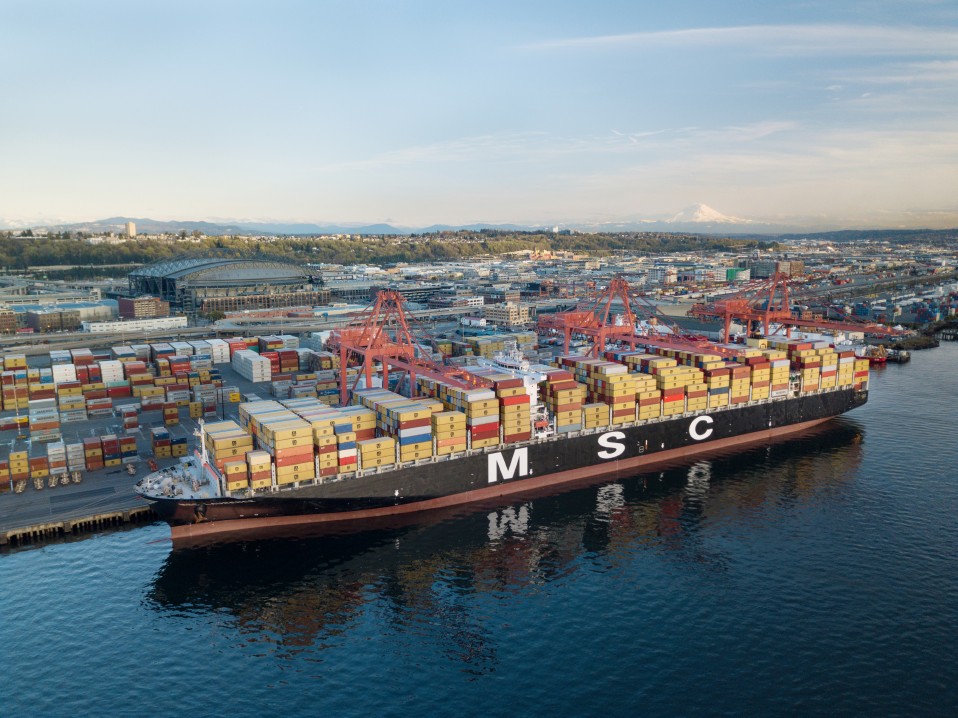
Image Source: MSC
MSC (Mediterranean Shipping Company) leads global shipping today and has set new industry standards through decades of smart expansion. Captain Gianluigi Aponte started the company in 1970 in Brussels with just one ship—the MV Patricia. The company grew into a family-owned enterprise now based in Geneva, Switzerland.
MSC Company Background
MSC started small but grew into a transportation giant that now runs container ships, trucks, trains, air cargo, and port terminals. The company has over 200,000 employees on every continent and runs a worldwide network that makes trade easier on a massive scale. MSC’s family ownership has helped it make quick decisions and plan for the long term without pressure from shareholders.
MSC 2025 Highlights
MSC runs approximately 900 cargo vessels with a total capacity of 5,505,417 TEU as of March 2025. The company’s fleet grew 5.5% in early 2025, adding 365,173 TEUs. The European Coffee Federation named MSC its “Shipping Line of the Year” for 2023-2024, showing its leadership in the industry.
MSC revealed its new East/West network in February 2025 after ending its 2M vessel sharing deal with Maersk. This network has:
- 34 loops across 5 trade routes
- Weekly services via both Suez Canal and Cape of Good Hope
- Over 1,900 direct port pairs
MSC Market Position
MSC stands as the world’s largest container shipping company with 20.6% of global container capacity as of June 2025. The company runs 524 offices in 155 countries and operates on more than 215 trade routes that connect over 500 ports worldwide. MSC took the top spot from Maersk in January 2022, reaching this milestone after fifty years of operation.
MSC Future Outlook
MSC aims to achieve net-zero fleet decarbonization by 2050. The company invests in sustainable technologies, including eco-friendly vessels and alternative fuels. MSC launched its record-breaking 24,000+ TEU Celestino Maresca class vessels in July 2023—designed to be the most fuel-efficient containerships. The company wants to adopt electronic Bills of Lading completely by 2030, pioneering maritime innovation for years to come.
Maersk
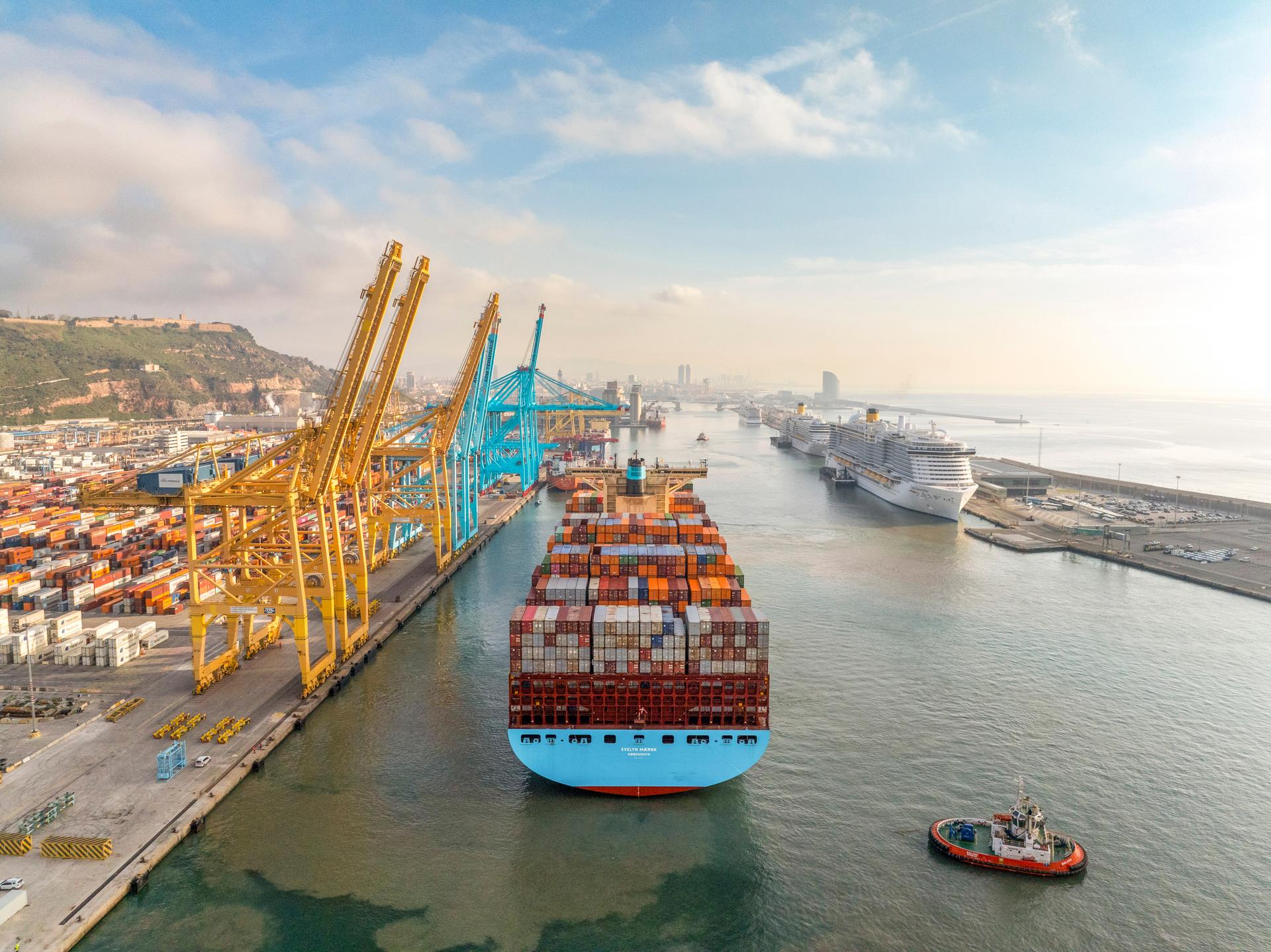
Image Source: Maersk
Maersk stands as the life-blood among the world’s largest container shipping companies. This 119-year old company evolved from a small Danish steamship enterprise into a global logistics powerhouse since 1904.
Maersk Company Background
A.P. Møller created the Steamship Company Svendborg on April 16, 1904, in a small town on the Danish island of Funen. The company started with just three vessels, though its roots trace back to 1886. That year, Peter Mærsk Møller (A.P. Møller’s father) bought his first steamship—LAURA. This father-son partnership ended up creating what we know today as A.P. Moller-Maersk.
Maersk 2025 Highlights
Maersk’s 2025 performance shows remarkable results. The company’s second-quarter revenue grew 2.8% with EBIT reaching $845 million. The Gemini Cooperation launch set new industry standards, and this is a big deal as it means that reliability scores reached over 90%. Ocean volumes saw a 4.2% year-over-year growth due to Asian exports. The company’s Terminals achieved record-high volumes with a 9.9% increase. Logistics & Services EBIT improved by 39%, reaching $175 million.
Maersk Market Position
Maersk holds the position of second-largest container shipping company globally with a 14.6% market share. The company employs about 100,000 people across more than 130 countries. Maersk has revolutionized beyond simple transportation and wants to become a “Global Integrator of logistics”. The company’s 2024 annual revenue touched $44.08 billion. This marked their third most profitable year with EBIT soaring 65% to $6.5 billion.
Maersk Future Outlook
Maersk’s 2025 forecast looks promising. The company expects global container market volume growth between 2% and 4%, higher than earlier projections. The company’s commitment to achieve net-zero GHG emissions by 2040 remains strong. They lead green shipping with methanol-powered vessels. Maersk revealed several methanol-enabled ships during 2023-2024, including LAURA MÆRSK, ANE MÆRSK, ASTRID MÆRSK, Alette Maersk, and Alexandra Maersk. The Science Based Targets initiative verified Maersk’s 2030 and 2040 targets, making them the first shipping company to achieve this milestone.
CMA CGM
CMA CGM, the French shipping giant, has become a powerhouse in global trade and stands among the largest container shipping companies through steady growth and innovation.
CMA CGM Company Background
Jacques Saadé established CMA CGM in Marseille, France in 1978. The company grew through organic expansion and strategic acquisitions. A merger with Compagnie Générale Maritime (CGM) in 1996 accelerated its growth. The company then acquired ANL (1998), Delmas (2005), and American President Lines (APL) in 2016. Rodolphe Saadé now leads this family-owned enterprise that has managed to keep its steadfast dedication to excellence for 47 years.
CMA CGM 2025 Highlights
CMA CGM achieved a significant milestone in early 2025 when it exceeded 4 million TEUs in operated capacity. The company launched an AI-driven logistics platform that optimizes cargo routing and supply chain efficiency. Several LNG-powered vessels joined the company’s fleet to strengthen its environmental commitments. The company’s financial performance showed remarkable results with revenue reaching $55.5 billion in 2024, an 18% increase from the previous year.
CMA CGM Market Position
The company ranks as the world’s third-largest container shipping company with 12.7% of global market share. Its fleet consists of 685 vessels that serve 420 of the world’s 521 commercial ports. CMA CGM’s global footprint spans 160 countries through 400 offices and 1,000 warehouses, with 160,000 employees worldwide.
CMA CGM Future Outlook
The company plans to invest $20 billion in the US maritime sector through 2029, which will create 10,000 new jobs. Carbon neutrality by 2050 remains a key goal. The company has ordered twelve 18,000 TEU dual-fuel LNG containerships that will arrive in 2028-2029. CMA CGM continues to revolutionize its business through AI and decarbonization investments while expanding in strategic markets like India and Brazil.
COSCO Shipping
COSCO Shipping, a state-owned enterprise, ranks as the fourth largest container shipping company in the world. The company’s influence in maritime logistics has grown steadily since it began operations.
COSCO Company Background
COSCO emerged from a merger between China Ocean Shipping Company and China Shipping Group in January 2016. The company’s roots go back to 1961, when China Ocean Shipping Company became China’s first international shipping venture. This 62-year old organization has transformed into a shipping giant that operates worldwide.
COSCO 2025 Highlights
COSCO’s performance in early 2025 shows remarkable growth. The company’s revenue jumped 7.8% year-on-year to CNY 109.10 billion. Their container shipping operations handled 13.28 million TEUs, which represents a 6.59% increase. The company’s terminal business brought in CNY 5.84 billion – a 14.75% increase. These terminals span 379 berths across 39 ports. COSCO now runs 557 vessels with a combined capacity of more than 3.4 million TEUs.
COSCO Market Position
COSCO commands 10.8% of the global market share. The company dominates the trans-Pacific route with a 15% share.
COSCO Future Outlook
The company focuses on digital intelligence and green development despite industry challenges. Market analysts expect revenue to drop 4.7% each year.
Hapag-Lloyd
German powerhouse Hapag-Lloyd stands as the fifth largest container shipping company with a legacy that spans back to the 19th century.
Hapag-Lloyd Company Background
The 1970 merger between Hamburg-Amerikanische Packetfahrt-Actien-Gesellschaft (HAPAG) and Norddeutscher Lloyd created Hapag-Lloyd. Both founding companies started their journey by sending cargo and passenger ships to New York. The company transformed from a traditional shipping enterprise into a global container transportation leader after acquiring CP Ships in 2005 and CSAV in 2014.
Hapag-Lloyd 2025 Highlights
The company’s fleet consists of 313 modern container ships with 2.5 million TEU transport capacity. Hapag-Lloyd transports 12.5 million TEU yearly and maintains 3.7 million TEU container capacity, including one of the world’s largest reefer container fleets. The company achieved significant results in H1 2025, reporting Group EBITDA of $1.9 billion and EBIT of $677 million. Transport volume increased by 11% despite market volatility.
Hapag-Lloyd Market Position
The company holds 7.0% of global market share as the fifth-largest container shipping company worldwide. A workforce of 17,100 people operates from more than 400 offices across 140 countries. The company’s network includes 133 liner services that connect over 600 ports globally.
Hapag-Lloyd Future Outlook
Strategy 2030 guides Hapag-Lloyd’s mission to become the “undisputed number one for quality”. Quality leadership integrates sustainability as a core component. The company expands its Terminal & Infrastructure segment through Hanseatic Global Terminals, with investments in 21 terminals throughout Europe, Latin America, the United States, India, and North Africa.
ONE – Ocean Network Express
Ocean Network Express (ONE) stands as the sixth largest player among the world’s largest container shipping companies. This 2017-born shipping giant operates a distinctive magenta-colored fleet that emerged from uniting three historic Japanese shipping lines.
ONE Company Background
The merger of Japan’s shipping titans—Kawasaki Kisen Kaisha (“K” LINE), Mitsui O.S.K. Lines (MOL), and Nippon Yusen Kaisha (NYK)—created ONE on July 7, 2017. Singapore hosts the company’s global headquarters, while regional offices span Hong Kong, the United Kingdom, the United States, Brazil, and UAE. The company started its commercial journey in April 2018. NYK holds a 38% stake in this unified entity, while MOL and K Line each maintain 31% ownership.
ONE 2025 Highlights
ONE’s financial performance soared during fiscal year 2024 (Apr 2024-Mar 2025). Revenue climbed to $19.23 billion, showing a 32% year-over-year growth, with net profit reaching $4.24 billion. Market volatility shaped the first quarter 2025 results, yielding $4.05 billion in revenue and $86 million in profit. The company strengthened its global presence by acquiring terminal stakes on the US West Coast and Rotterdam. The delivery of its first 24,000 TEU Megamax class vessel, “ONE INNOVATION,” marked another milestone.
ONE Market Position
ONE’s fleet now includes over 260 vessels with capacity surpassing 2 million TEUs. The company serves more than 120 countries through its comprehensive network. February 2025 saw ONE join the Premier Alliance, which took over from THE Alliance. The company’s global workforce of 8,000 employees operates from 200+ offices across 47 countries, serving 14,000+ clients worldwide.
ONE Future Outlook
Geopolitical uncertainties, changing market conditions, and port congestion pose significant challenges ahead. The company revised its full-year profit forecast down to $700 million from the original $1.1 billion projection. All the same, ONE continues to optimize its cargo portfolio and vessel deployment while tackling logistical challenges. These strategic adjustments help maintain agile operations in today’s challenging global environment.
Evergreen Marine
Taiwan’s Evergreen Marine ranks among the world’s largest container shipping companies. The company operates with a philosophy that combines profit creation, employee care, and social responsibility to accelerate its growth.
Evergreen Company Background
Dr. Yung-Fa Chang founded Evergreen on September 1, 1968, with a single 15-year-old general cargo ship named “Central Trust”. The company pioneered Taiwan’s first containerization project during a global energy crisis in 1975. Evergreen achieved a significant milestone in 1984 by launching eastbound and westbound round-the-world liner services. The company became the world’s largest container carrier by 1985.
Evergreen 2025 Highlights
Evergreen’s current fleet consists of 223 container vessels with a carrying capacity of 1,759,089 TEUs. The company earned revenue of NTGBP 20.94 billion (approximately USD 870 million) in May 2025, showing a year-on-year decrease of 18.0%. The first five months of 2025 brought cumulative revenue of NTGBP 132.11 billion (USD 5.15 billion), marking a 9.0% increase.
Evergreen Market Position
Evergreen’s mutually beneficial alliances have helped it rank 7th globally among container carriers. The company’s vessels serve more than 240 ports in 80 countries.
Evergreen Future Outlook
Evergreen invests in eco-friendly vessels and plans to raise transpacific contract rates for 2025. The company maintains its dedication to environmental protection and corporate sustainability.
HMM – Hyundai Merchant Marine
South Korean powerhouse HMM, which rebranded from Hyundai Merchant Marine in 2020, stands as the eighth largest among largest container shipping companies worldwide.
HMM Company Background
The company started small in 1976 with just three VLCCs (Very Large Crude Carriers) and grew into a global integrated logistics leader. HMM serves as the economic backbone of South Korea’s economy by handling imports, exports and strategic cargo. Despite facing multiple challenges, the company expanded steadily to become a driving force in Korean maritime operations.
HMM 2025 Highlights
The company’s financial performance in 2024 showed remarkable results with revenue of KRW 11,700 billion and net profit of KRW 3,781 billion. HMM managed to keep a strong 30% operating margin that proved its competitive edge in global shipping. The company’s revenue reached KRW 2.85 billion in Q1 2025, while net profit jumped 52% to KRW 740 billion.
HMM Market Position
HMM currently operates a fleet capacity of 941,019 TEU, which represents 2.9% of the global market. The company runs about 130 modern vessels efficiently.
HMM Future Outlook
The company’s bold 2030 strategy aims to expand its fleet to 240 vessels and boost container capacity from 920,000 TEU to 1.5 million TEU. HMM made a strategic shift from THE Alliance to join the Premier Alliance in March 2025.
Yang Ming
Yang Ming takes its philosophical name from Chinese thinker Wang Yangming. The company embraces his principle of “the unity of knowing and doing” and stands among the world’s largest container shipping companies.
Yang Ming Company Background
Yang Ming Marine Transport Corporation started its journey in 1972 in Keelung, Taiwan. The company’s rich history connects to China Merchants Steam Navigation Company (1872-1995), which dates back to the Qing Dynasty. We transformed from a dry bulk transport company into a global container shipping powerhouse. Yang Ming’s operations now span multiple locations in Taiwan, including Taipei, Geelong, Taichung, and Kaohsiung.
Yang Ming 2025 Highlights
Q2 2025 results show:
- Consolidated revenue of NTGBP 30.70 billion (USGBP 0.96 billion)
- After-tax net profit of NTGBP 0.79 billion (USGBP 24.54 million)
- EPS of NTGBP 0.22
The carrier’s fleet now includes 100 vessels with 726,585 TEU capacity. This represents an addition of 2 vessels and 9,366 TEUs compared to 2024.
Yang Ming Market Position
Yang Ming’s extensive service network reaches over 70 nations through more than 170 service points. The company made a strategic move in March 2025 by joining the Premier Alliance. This new partnership, which replaced THE Alliance, includes HMM, Ocean Network Express, and other carriers.
Yang Ming Future Outlook
Trade uncertainties shape Yang Ming’s strategy toward reliable service delivery and flexible capacity management while exploring new markets. The company pushes forward with its fleet optimization program by replacing older vessels with energy-efficient ships.
ZIM Shipping
ZIM, sailing under the Israeli flag, ranks as the tenth largest container shipping company worldwide. The company’s distinctive blue and white vessels command a 2.3% global market share.
ZIM Company Background
The Jewish Agency, Israel Maritime League, and Histadrut Labor founded ZIM in 1945. The company bought its first vessel “Kedmah” in 1947. During Israel’s War of Independence, ZIM’s early fleet played a crucial role by transporting European immigrants and delivering vital supplies to the newly formed state. The company shifted its focus from passenger service to cargo transport by the late 1960s. The 1970s marked a substantial expansion through container shipping.
ZIM 2025 Highlights
The company’s first quarter 2025 results showed remarkable performance with revenue of £1.60 billion, a 28% year-over-year increase, and net income reaching £235.07 million. The second quarter proved challenging as revenue dropped 15% to £1.30 billion and net income fell 94% to £19.06 million. The company raised its full-year adjusted EBITDA guidance to £1.43-£1.75 billion despite these challenges.
ZIM Market Position
The company’s fleet consists of over 260 vessels with a capacity of 761,715 TEUs. ZIM serves roughly 33,000 customers through 330+ ports in more than 100 countries. The company’s business model remains distinctly asset-light with 95% chartered vessels.
ZIM Future Outlook
The company projects lower freight rates and flat volumes through 2025. All the same, ZIM’s commitment to sustainability shows in its fleet transformation – 40% will run on LNG by year-end. This positions ZIM as a game-changer in reducing carbon intensity while pursuing its net-zero emissions target by 2050.
OOCL – Orient Overseas

Image Source: OOCL
Orient Overseas Container Line (OOCL), based in Hong Kong, stands among the largest container shipping companies worldwide. The company’s maritime excellence spans more than 70 years.
OOCL Company Background
C.Y. Tung brought his vision to life by founding OOCL in 1947. His achievement marked a milestone as the first Chinese merchant fleet reached the Atlantic coast of the USA and Europe with an all-Chinese crew. The company started as Orient Overseas Line but changed its name to Orient Overseas Container Line in 1969 to reflect the rise of containerization. Leadership passed through the family, with C.H. Tung taking charge in 1982 after the founder’s death, followed by C.C. Tung in 1996. COSCO SHIPPING Holdings acquired OOCL’s parent company, Orient Overseas International Limited (OOIL), in 2018.
OOCL 2025 Highlights
OOCL posted remarkable results during the first half of 2025 despite market challenges. The company’s revenue grew by 4.9% to $48.76 billion USD, while net profit jumped to $9.54 billion USD – a 14.5% increase from 2024. Cargo volume reached 3.70 million TEU, showing strong growth of 9% from the previous year. The company added five 16,828 TEU vessels to its fleet and placed orders for fourteen 18,500 TEU methanol dual-fuel container ships scheduled for 2028-2029 delivery.
OOCL Market Position
The company’s fleet ranges from 2,992 TEU to 24,188 TEU vessels, with a total fleet capacity of 4.7 million TEU. OOCL made history in 2017 when its vessel, OOCL Hong Kong, became the first container ship to break the 21,000 TEU barrier, earning a Guinness World Record. The company’s global presence includes about 100 offices across 70 countries, supported by its membership in the Ocean Alliance.
OOCL Future Outlook
OOCL builds stronger partnerships with COSCO SHIPPING Lines to optimize costs and spread risks. The company embraces digital innovation by incorporating AI into its network planning and vessel management systems. OOCL’s environmental efforts have cut average carbon emissions per shipping unit by 53% since 2008. This commitment earned OOCL the title of “Best Green Shipping Line” at the 2024 Asian Freight, Logistics and Supply Chain Awards.
PIL – Pacific International Lines
Pacific International Lines (PIL), based in Singapore, has evolved from modest beginnings to become a formidable player among the largest container shipping companies.
PIL Company Background
Singaporean entrepreneur Chang Yun Chung (the world’s oldest billionaire until his death at 102 in 2020) founded PIL in 1967 with just two vessels. The company climbed into the top 10 container shipping lines globally before its 50th anniversary in 2017. PIL strengthened its position by acquiring majority shareholding in Singapore’s Mariana Express Lines in March 2015. The company expanded beyond shipping through a blockchain supply platform in 2018. Its operations now include logistics services, container manufacturing, ship recycling, and supply chain management.
PIL 2025 Highlights
PIL’s financial performance in FY2024 showed remarkable growth. The company’s net profit after tax reached USGBP 1.07 billion, quadrupling from USGBP 243.75 million in 2023. Revenue grew 49% year-on-year to USGBP 3.42 billion. Container shipping remained the core business, generating over 87% of total revenue. The company’s balance sheet stays robust with cash reserves of USGBP 1.85 billion.
PIL Market Position
PIL ranks among the top 12 container shipping lines worldwide and leads Southeast Asia as its largest home-grown carrier. The company’s fleet includes about 100 container vessels that serve more than 90 countries through 500 ports globally.
PIL Future Outlook
CEO Lars Kastrup sees 2025 bringing “uncertainty and heightened challenges”. The market faces potential oversupply as new vessel capacity might exceed demand. However, ongoing port congestion could help balance this excess capacity. PIL’s strong cash position enhances its resilience as the company pursues further growth opportunities.
Wan Hai Lines
Taiwanese container carrier Wan Hai Lines stands out among the largest container shipping companies with its focus on intra-Asian routes and steady global expansion.
Wan Hai Company Background
Wan Hai’s journey began in 1965 as a log transportation enterprise. The company transformed into a fully containerized shipping operation after acquiring its first container vessel, MV ‘Ming Chun’, in 1976. The company’s strategic expansion led to Japanese market entry in 1983, where it established market leadership, followed by Southeast Asian operations in 1989. Wan Hai managed to keep a practical approach to growth and optimized operational efficiency by numbering its vessels instead of naming them.
Wan Hai 2025 Highlights
Wan Hai earned the “Best Container Liner of Latin America & Central America Route” award at the Thai National Shippers’ Council Awards in 2025. The company saw a 112.8% year-on-year profit decline in April 2025, though its Q1 2025 results showed 90% higher net profit compared to 2024. The company now runs seven service routes in Thailand.
Wan Hai Market Position
The company ranks 11th globally and operates a fleet of 123 ships with 525,923 TEU capacity. Wan Hai serves all but one of these main trades, having exited the Far East-Europe route in 2019.
Wan Hai Future Outlook
While facing an expected annual revenue decline of 15.2%, Wan Hai has ordered 20 methanol dual-fuel vessels in the 8,000-8,700 TEU range. The company received an invitation to join a shipping alliance that could enable its return to the Far East-Europe trade.
SITC International
SITC International Holdings stands out among the largest container shipping companies with its unique high-frequency, small-vessel strategy that drives its success across Asian markets.
SITC Company Background
The 31-year-old Shandong International Transportation Corp started its first container service between China and Japan after acquiring the vessel “UNION FORTUNE” in 1992. SITC’s expansion reached South Korea in 1994, and the company reorganized as SITC Group in 1996. The company went fully private in 2001 and achieved a major milestone with its listing on the Hong Kong Stock Exchange in 2010.
SITC 2025 Highlights
The first half of 2025 showed remarkable results as revenue jumped 28% to GBP 1.32 billion and net profit reached GBP 503.02 million, up by 79.5%. Container shipping volume grew 7.3% while freight rates rose 22.8% to USGBP 616.27/TEU. SITC’s network now spans 78 trade lanes with 489 weekly port calls.
SITC Market Position
SITC ranks 15th globally in shipping capacity and holds the fourth position in the Intra-Asia market. The company’s fleet includes 119 vessels with 185,787 TEU capacity, and 95 of these ships are smaller than 2,000 TEU.
SITC Future Outlook
Market uncertainties push SITC to invest in AI applications and expand its fleet with four new 2,700-TEU containerships. The company focuses on customer retention, operational optimization, and cost control to maintain profitable growth.
KMTC – Korea Marine Transport
Korean private carrier KMTC stands among the largest container shipping companies with expertise in intra-Asia routes.
KMTC Company Background
KMTC’s journey began in 1954 when Korea Marine Transport Co., Ltd. started maritime transportation between Korea and Japan. The company expanded to international multimodal transport in 1986 and launched air cargo operations in 1988. KMTC merged with Korea Marine Transport’s multimodal division in 1997 to become a leading logistics provider.
KMTC 2025 Highlights
KMTC revealed a strategic weekly service between Asia and Mexico in April 2025, marking its return to transpacific routes after 40 years. The service travels through Shanghai, Qingdao, Busan, and Manzanillo. KMTC Middle East handles transshipment through Jebel Ali Port to direct cargo from the Gulf region to Mexico.
KMTC Market Position
KMTC’s fleet capacity of 152,554 TEUs places it among the top 20 global container carriers. The company operates across 10+ countries through 30+ offices with a workforce of 1,000 logistics professionals. Thailand emerges as KMTC’s largest Southeast Asian market with 18 weekly services.
KMTC Future Outlook
KMTC expands globally while optimizing its network effectively. The company invests in eco-friendly technologies and upgrades its digital booking platforms.
Zhonggu Logistics
Chinese domestic giant Zhonggu Logistics has climbed to join the ranks of the largest container shipping companies by revolutionizing China’s logistics sector through containerization.
Zhonggu Company Background
This 20-year old enterprise started as one of China’s earliest domestic trade container shipping specialists and has grown into a complete business. The company integrates container shipping, warehousing, ship management, port operations, and financial services. More than 2,000 staff members work across 200+ branches throughout China.
Zhonggu 2025 Highlights
The company’s financial strength shows in its impressive net profits of RMB1.54bn for the first half of 2022, a 40% increase from the previous year. Zhonggu continues to grow its fleet with eighteen 4,600 TEU containership contracts from Chinese shipyards. The company is building an advanced multi-model container logistics park in Qinzhou that will house China’s most sophisticated inland container yard.
Zhonggu Market Position
Zhonggu holds the 13th position globally in transport capacity according to Alphaliner data. The company’s fleet consists of 116 vessels with 171,459 TEU total capacity, making it China’s largest domestic containerline. Its service network reaches more than 100 ports across China through an innovative “Three transverse and one lengthwise” structure.
Zhonggu Future Outlook
The company has expanded beyond its domestic success and entered international markets with a new Southeast Asia service that connects Shanghai, Ningbo and Ho Chi Minh City. Two 1,912 TEU boxships support this strategic move into international waters.
X-Press Feeders
Singapore-based X-Press Feeders stands out as the world’s largest independent common feeder carrier among the largest container shipping companies. The company provides specialized services without competing directly with its customers.
X-Press Feeders Company Background
This 52-year old company has grown from its regional Southeast Asian roots to a global network that now spans Asia, Middle East, Africa, Caribbean, Latin Americas, Mediterranean, and Europe. The company’s core team includes 500+ staff members and a network of dedicated agents worldwide. X-Press Feeders operates as a shipper-owned carrier that doesn’t own, lease, or operate containers—they focus on providing transportation services exclusively to container operators.
X-Press Feeders 2025 Highlights
The company expects a “relatively healthy supply-demand balance” in 2025 despite traffic challenges. They won the Marine Money 2024 East Leasing Deal of the Year with their French leasing arrangement with six dual-fuel methanol vessels worth over GBP 222.36 million. Their green methanol-powered feeder network has reduced CO₂ emissions by up to 65% per vessel significantly.
X-Press Feeders Market Position
X-Press Feeders leads the market with 110 vessels (43 owned). Their annual capacity of over 6 million TEUs makes them the leading feeder carrier ahead of Unifeeder.
X-Press Feeders Future Outlook
The company sees growing adoption of hybrid fuel systems and plans to invest more in digital technologies. They have ordered fourteen dual-fuel vessels to be delivered between 2024-2026. This shows their steadfast dedication to achieving net-zero carbon emissions by 2050.
SeaLead Shipping
SeaLead has become one of the largest container shipping companies since its launch in 2017, growing faster than many competitors in the industry.
SeaLead Company Background
This Singapore-headquartered company started with a single vessel that provided feeder services in the Red Sea and expanded to the Middle East by 2018. The company launched long-haul services between China and the Middle East in 2020, and added East Asia-US West Coast routes in 2021. Under new CEO Suleyman Avci, who brings 30+ years of industry expertise, SeaLead continues its bold expansion strategy.
SeaLead 2025 Highlights
SeaLead earned significant recognition in 2025, winning “Promising Liner Operator of the Year” at the Global Ports Forum Awards and “Sea Freight Provider of the Year” at the Logistics & Transport Awards. The company attracted four new investors with multi-million USD assets. A new five-member Board of Directors brought 180 years of combined industry experience.
SeaLead Market Position
SeaLead holds the 13th position in Alphaliner’s global carrier rankings. The company’s fleet includes 40+ vessels that serve 77 ports across 51 countries. SeaLead’s container volume reached 1.8 million TEUs in 2024.
SeaLead Future Outlook
The company plans to strengthen its global presence in 2026 by expanding services and delivering trailblazing logistics solutions.
Comparison Table
Conclusion
Global maritime commerce in 2025 shows its dynamic nature through the performance of major shipping giants. MSC’s historic rise above Maersk marked the most important power move, while companies at every level adapted to market changes. These industry leaders proved remarkably resilient despite major challenges, including 5,500-mile diversions around the Suez Canal that added 7-10 days and substantial fuel costs to voyages.
These shipping powerhouses stand out through their dedication to breakthroughs. MSC built record-breaking vessels exceeding 24,000 TEU capacity. Maersk pushed aggressively toward net-zero emissions by 2040. CMA CGM developed AI-driven logistics platforms. Yet these represent just a fraction of technological breakthroughs reshaping maritime logistics.
Sustainability now creates competitive advantage, and major carriers know this well. Many have clear decarbonization roadmaps and invest heavily in methanol-powered vessels and alternative fuels. Digital transformation has become a necessity rather than a choice. Electronic documentation, AI-powered routing, and advanced cargo tracking systems are now standard offerings.
Market consolidation keeps reshaping the industry’s map through strategic collaborations forming and reforming. The Premier Alliance’s replacement of THE Alliance shows how these shipping giants constantly adjust their partnerships to maintain operational efficiency and global coverage.
A closer look at these 20 shipping giants reveals their combined influence on global trade. They control essential goods movement across continents and serve as the global economy’s circulatory system. Their ongoing development through strategic investments, technological adoption, and sustainability initiatives will shape international commerce’s future path.
The world’s largest container shipping companies face unprecedented challenges and opportunities. Market volatility, geopolitical tensions, and environmental regulations create hurdles but also drive breakthroughs. Without doubt, companies that best balance operational efficiency, technological advancement, and environmental responsibility will lead global trade for decades.
Key Takeaways
The global container shipping industry is dominated by 20 major companies that control the flow of international trade, with significant market shifts and technological innovations reshaping the maritime landscape.
• MSC overtook Maersk in 2022 to become the world’s largest container shipping company, commanding 19.9% global market share with over 900 vessels.
• Top five carriers (MSC, Maersk, CMA CGM, COSCO, Hapag-Lloyd) control 64.9% of global container capacity, demonstrating significant market concentration.
• Industry leaders are investing heavily in sustainability, with Maersk targeting net-zero emissions by 2040 and multiple carriers deploying methanol-powered vessels.
• Suez Canal disruptions force 5,500-mile diversions around Cape of Good Hope, adding 7-10 days and substantial fuel costs to shipping routes.
• Digital transformation is accelerating across the sector, with AI-driven logistics platforms, electronic documentation, and advanced cargo tracking becoming standard.
The shipping industry’s future depends on balancing operational efficiency with environmental responsibility, as these maritime giants continue adapting to geopolitical challenges while maintaining their critical role in global commerce.
FAQs
Q1. Which company leads the container shipping industry in 2025? MSC (Mediterranean Shipping Company) is the largest container shipping company in 2025, commanding a 19.9% global market share with a fleet of approximately 900 vessels.
Q2. What is the capacity of the world’s largest container ship in 2025? The largest container ship as of 2025 is the MSC Irina, with a staggering capacity of 24,346 TEUs (Twenty-foot Equivalent Units).
Q3. How has the ranking of top shipping companies changed in recent years? A significant shift occurred in 2022 when MSC overtook Maersk for the first time since 1996 to become the world’s largest container shipping company. This change reshaped the industry landscape.
Q4. What major challenges are container shipping companies facing in 2025? Container shipping companies are grappling with market volatility, geopolitical tensions, and stringent environmental regulations. They also face operational challenges such as port congestion and the need to reroute vessels around the Suez Canal, adding significant time and costs to voyages.
Q5. How are shipping companies addressing environmental concerns? Many major carriers have established clear decarbonization roadmaps. For instance, Maersk aims to achieve net-zero emissions by 2040, while others are investing in methanol-powered vessels and alternative fuels. There’s an industry-wide push towards sustainability and reducing carbon footprints.
Freightender – Ocean Procurement software
Freightender is the fastest-growing ocean procurement software provider in the world. We are over 10 years active in logistics procurement technologies, serving 120+ customers for all modes of transportation. Our intuitive cloud-based procurement platform can launch any type of sourcing event for Air, Ocean, FTL, LTL and parcel/courier.
